Certainly! Below is a rewritten version of the provided text, followed by a detailed expansion of the topics mentioned, structured with appropriate headings:
—
Key Takeaways
The Discovery and Origins of Wat Pranon
A monk unearthed the historical narrative of Wat Pranon through Nhan Kat, a native of Chiang Mai who once resided at Wat Pra Sigha. This legend was documented in an ancient palm leaf manuscript, revealing that Wat Pranon was established by Chao Phraya Chaichana Songkram and Phra Nang Chao U-Tong Sri Pimpa in the year 236 of the Chula Sakarat calendar. This lunisolar calendar was introduced in 638 CE by Phraya Kanwandit during a gathering of Lanna kings who agreed to adopt it over the Mahasakaraj calendar, previously standard in the Khmer Empire. It is believed that when Ayutthaya officially embraced the Chula Sakarat, its foundational era was derived from the Burmese calendar. The Chula Sakarat was extensively utilized across various kingdoms, including Lanna, late Sukhothai, and Ayutthaya. King Prasattong later replaced it with the Chula Manee Era, resulting in a three-year delay in the zodiac. Eventually, Chula Sakarat was reinstated and continues to be used today. To convert a Chula Sakarat year to the Buddhist era in the Thai calendar, one must add 1181 to the Chula Sakarat year.
The Construction and Transformation of Wat Pranon
Initially, Wat Pranon housed a genuine three-meter-long reclining Buddha statue crafted from rock. However, Chao Pu Tao Ka, the prosecutor for Phraya Chai Chana Songkram, deemed it unsafe. Consequently, he ordered the statue to be encased in a larger reclining Buddha sculpture, which was ornately decorated. This transformation coincided with a Burmese invasion of Koh Sai town, prompting its residents to flee into the forests, fearing for their safety before they could celebrate the new Buddha image. Chao Phraya Chana Songkram expressed to his wife, Pimpa, that the invasion had caused turmoil in the town, and he wished to complete the statue and hold a celebration the following day. Unfortunately, Chao Phraya Chana Songkram perished in battle, and his brother, Tao Ya Sid Saanharn, went missing. In response, Pimpa constructed Wat Pranon’s pagoda and inscribed a golden stone with local characters, declaring that Wat Pranon should be honored annually on the full moon day of June.
Rediscovery and Restoration of Wat Pranon
For a lengthy period, the temple was abandoned, as the town lacked a governor. Over time, trees and plants grew profusely, enveloping the area, and thick vines obscured the Buddha statue, transforming the site into a forest. Eventually, a merchant from another town spent the night in the area and intended to use the vines for sustenance, only to discover bricks. He suspected that the area was a deserted temple and informed the townspeople. Excited by the finding, they assisted in clearing the site, uncovering a vast mango tree that provided shade to the image. The community’s faith was rekindled, leading to the temple’s restoration, and it was subsequently renamed "Wat Ton Mamuang" (The Mango Tree Temple). They also discovered Pimpa’s inscription, confirming that Wat Ton Mamuang was formerly Wat Pranon. This golden inscription has established Wat Pranon as one of the ancient sacred sites in Phrae Province and later transformed it into a popular tourist destination. Officially recognized in 777, the temple was granted certification of its status on June 9, 1993.
Architectural Features of Wat Pranon
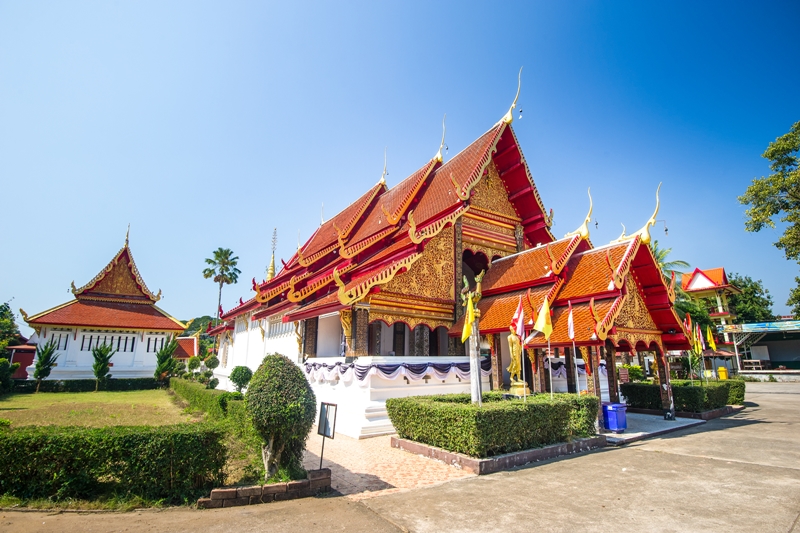
Ubosot: Constructed in the Chiang Saen style, the Ubosot is unique for its lack of windows, allowing sunlight to illuminate its interior. The front is adorned with perforated designs from the late Ayutthaya period and features paintings from the Ramayana.
Buddha Image Hall: Sharing the architectural style of the Ubosot, the Buddha Image Hall features eaves that are perforated all around. The roof is enhanced with wood carvings depicting the King of Nagas on the gable.
Reclining Buddha Image: The temple is home to a cement Buddha image coated with gold leaf, measuring five meters in length.
Pagoda: Situated behind the Ubosot, the pagoda is designed with an upside-down octagonal bell shape, complete with Buddha images on all four sides.
Cultural and Historical Significance
Wat Non, revered for generations, was once known as "Muang Kum." This heritage site in Phrae is a source of pride, having been preserved and cherished through the ages.
—
Detailed Expansion
Introduction to Wat Pranon’s Historical Context
Wat Pranon’s history is deeply intertwined with the cultural and political shifts in Southeast Asia. The temple’s origins date back to a time when the region was a mosaic of kingdoms, each with its own traditions and systems of governance. The adoption of the Chula Sakarat calendar by Lanna kings, as revealed in the ancient palm leaf manuscript, marks a significant moment in this history. This transition from the Mahasakaraj, the Khmer Empire’s standard calendar, to the Chula Sakarat reflects broader regional interactions and the influence of neighboring cultures, particularly the Burmese.
The establishment of Wat Pranon by Chao Phraya Chaichana Songkram and Phra Nang Chao U-Tong Sri Pimpa highlights the temple’s foundational role in the spiritual and cultural life of the community. The temple’s story, as recounted by Nhan Kat, a figure from Chiang Mai, underscores the interconnectedness of different regions within thailand and beyond. The adoption of the Chula Sakarat by Ayutthaya, believed to be influenced by the Burmese calendar, further illustrates the complex web of cultural exchanges that shaped the historical landscape of Southeast Asia.
The Architectural Evolution of Wat Pranon
Wat Pranon’s architectural journey is reflective of the artistic and religious influences that have permeated the region over centuries. The transformation of the original three-meter-long reclining Buddha statue into a larger, more ornate figure encapsulates the temple’s enduring significance and the community’s commitment to preserving its spiritual heritage. Chao Pu Tao Ka’s decision to encase the original statue within a grander structure was not only a response to concerns about safety but also an expression of the community’s devotion and artistic ingenuity.
The temple’s architectural features, such as the Chiang Saen-style Ubosot and the intricately carved Buddha Image Hall, demonstrate the fusion of artistic styles and religious symbolism. The use of perforated designs from the late Ayutthaya period and the depiction of Ramayana scenes reflect the blending of local and regional artistic traditions. The pagoda’s unique upside-down octagonal bell shape and the presence of Buddha images on all sides further underscore the temple’s architectural and spiritual significance.
The Cultural Renaissance and Rediscovery of Wat Pranon
Wat Pranon’s rediscovery and subsequent restoration represent a cultural renaissance that has breathed new life into this ancient site. The tale of the merchant who stumbled upon the deserted temple and the community’s enthusiastic response to the discovery highlights the enduring connection between the local population and their cultural heritage. The transformation of Wat Pranon into Wat Ton Mamuang, or The Mango Tree Temple, symbolizes the community’s commitment to preserving and honoring their historical roots.
The restoration process, guided by the golden inscription left by Pimpa, has rekindled a sense of pride and identity among the people of Phrae Province. Wat Pranon’s recognition as one of the ancient sacred sites in the region and its subsequent transformation into a popular tourist attraction underscore its significance as a cultural and historical landmark. The temple’s official certification in 1993 further solidifies its status as a treasured heritage site, ensuring its preservation for future generations.
The Legacy and Significance of Wat Pranon
Wat Pranon’s legacy is a testament to the enduring power of cultural heritage and the role of historical sites in shaping community identity. The temple’s history, marked by periods of decline and renewal, reflects the resilience and tenacity of the local population in preserving their cultural and spiritual traditions. Wat Pranon’s transformation from a deserted temple to a vibrant cultural landmark illustrates the dynamic nature of cultural heritage and its capacity to inspire and unite communities.
The temple’s architectural features, historical significance, and cultural legacy continue to attract visitors from around the world, offering a window into the rich tapestry of Southeast Asia’s history and cultural heritage. As a symbol of pride and identity for the people of Phrae, Wat Pranon serves as a reminder of the importance of preserving and honoring the cultural legacies that connect us to our past and shape our future.
Conclusion
Wat Pranon stands as a beacon of cultural heritage and historical significance, embodying the rich traditions and artistic influences that have shaped Southeast Asia over centuries. Its history, architectural evolution, and cultural renaissance offer valuable insights into the region’s complex and interconnected past. As a testament to the resilience and tenacity of the local population, Wat Pranon continues to inspire and unite communities, serving as a cherished symbol of pride and identity for the people of Phrae Province and beyond.
Address And Location:
Phra Non Nuea Road Nai Wiang Mueang Phrae Phrae 54000