Key Takeaways
Wat Khao Di Salak: A Historical and Cultural Treasure
Introduction
Located in Mu 5, Donka, just 8 kilometers from U Thong, Wat Khao Di Salak is a temple of historical and cultural significance. The temple is renowned for its imitation of Lord Buddha’s footprint, which was studied in 1992 by the Fine Arts Department under the guidance of Mr. Baanhan Silpa-acha. This article explores the temple’s history, the significance of the Buddha’s footprint, the architecture, and how to visit this remarkable site.
The Historical Significance of Wat Khao Di Salak
Wat Khao Di Salak holds a prominent place in Thai history due to its unique feature: a reproduction of Lord Buddha’s footprint. In 1992, the Fine Arts Department conducted a study to authenticate its age and origin. The findings revealed that the footprint is likely from the same era as another located in Saraburi. Subsequently, it was declared a national antique, underscoring its historical importance.
The temple gained further recognition when Princess Sirindhorn attended its opening ceremony in 1999, marking it as a site of national interest. The temple has since become a cherished tourist attraction, celebrated for its rich cultural and historical heritage.
Architectural Marvel: The Buddha’s Footprint
The reproduction of Lord Buddha’s footprint at Wat Khao Di Salak is an architectural marvel. Made from red sandstone tiles, the footprint is rectangular and decorated with tiny lotus petals. The toes of the footprint are distinct, featuring two joints each. The first section of the toes showcases a volute pattern, influenced by the Mahabut-laksana scripture, also known as the Mahaparit-lukana, as depicted in the Patom-sompot-ghata in Bali and the Lilit-visuth scripture in Sanskrit. The second section displays a coiled leaf pattern typical of Dvaravati art, often seen in stuccos.
The uniqueness of the footprint reproduction lies in its Dvaravati-era style, characterized by a small Thammachak (wheel) with 16 smaller wheels at the foot’s center, encircled by 108 auspicious symbols. The footprint’s base is curved, measuring 65.5 by 141.5 centimeters, and is believed to date back to the 14th-16th Buddhist Era.
Exploring the Temple Grounds
Beyond the Buddha’s footprint, Wat Khao Di Salak offers visitors a chance to explore various historical artifacts. The temple houses a cave with a central Buddha image, surrounded by ancient objects, providing a glimpse into the past. The temple’s serene environment and historical significance make it a must-visit destination for history enthusiasts and spiritual seekers alike.
Visiting Wat Khao Di Salak
For those interested in visiting Wat Khao Di Salak, the journey is straightforward. Start by taking highway 340, then turn left onto route 357 before reaching Supan Buri city center. Continue for 10 kilometers and turn left onto Malai Maen Street (321). Travel 21 kilometers towards U Thong. Upon reaching the U Thong junction, take a right turn. The temple entrance is 3 kilometers after the junction. Once at the entrance gate, proceed for another 10 kilometers to reach the hill track leading to the temple’s peak.
For further inquiries, visitors can contact the temple at 0 3542 1444 or 08 1197 4974.
Conclusion
Wat Khao Di Salak is more than just a temple; it is a repository of Thai history and culture. With its unique reproduction of Lord Buddha’s footprint, rich architectural details, and serene surroundings, the temple offers a profound experience for all who visit. Whether you are drawn by spiritual curiosity or a passion for history, Wat Khao Di Salak promises an enriching journey through time.
—
Detailed Exploration of Wat Khao Di Salak
The Relevance of the Buddha’s Footprint
The imitation of Lord Buddha’s footprint at Wat Khao Di Salak is not only a historical artifact but also a symbol of spiritual significance. In Buddhist tradition, the Buddha’s footprint represents the presence of the Buddha and serves as a reminder of his teachings. The intricate designs and symbols on the footprint are imbued with meaning, each representing aspects of the Buddha’s life and virtues.
The footprint’s design is a testament to the artistic prowess of the Dvaravati period, reflecting the cultural and religious influences of the time. The volute and coiled leaf patterns are not mere decorations but are steeped in religious symbolism, representing the path to enlightenment and the cycle of life and rebirth.
The Dvaravati Era and Its Influence
The Dvaravati era, spanning from the 6th to the 11th centuries, was a significant period in Thai history. It was marked by the spread of Theravada Buddhism and the flourishing of art and architecture. The Dvaravati style is characterized by its intricate stucco work, sophisticated iconography, and spiritual themes, all of which are evident in the reproduction of the Buddha’s footprint at Wat Khao Di Salak.
The 16 smaller wheels and 108 auspicious symbols on the footprint are quintessentially Dvaravati, reflecting the era’s emphasis on religious symbolism and spiritual expression. These elements serve as a visual representation of Buddhist teachings, encouraging devotees to reflect on their spiritual journey.
Architectural Features of Wat Khao Di Salak
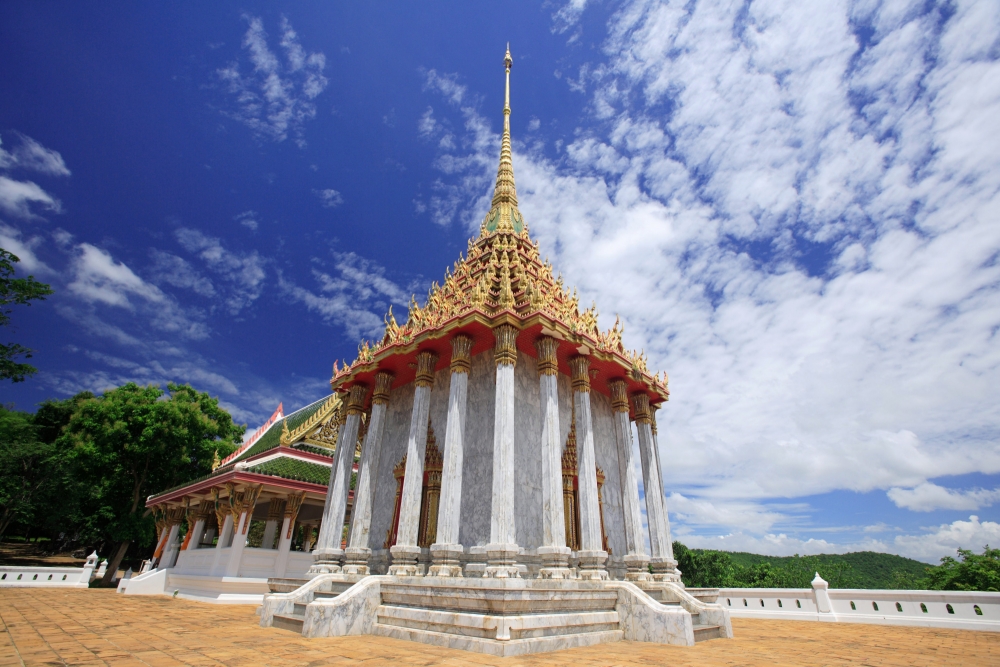
Aside from the Buddha’s footprint, Wat Khao Di Salak boasts several architectural features that draw visitors. The temple’s peak-topped roof, constructed to shelter the footprint, is a blend of traditional Thai architecture and modern design. It serves not only as a protective structure but also as a visual highlight of the temple complex.
The temple’s layout is designed to guide visitors on a spiritual journey, with pathways leading to various points of interest, such as the cave housing the Buddha image. The use of natural materials and the integration of the temple into its surrounding landscape reflect a deep respect for nature and a desire to create a harmonious environment conducive to meditation and reflection.
The Cultural and Spiritual Experience
Visiting Wat Khao Di Salak is more than just a sightseeing trip; it is an opportunity to immerse oneself in Thai culture and spirituality. The temple offers a tranquil setting for meditation and contemplation, allowing visitors to connect with their inner selves and gain insight into Buddhist teachings.
The temple’s historical artifacts and cultural displays provide a window into thailand‘s rich heritage, offering a deeper understanding of the country’s religious and artistic traditions. For those interested in learning more about Buddhism, the temple provides a wealth of information and resources, making it an educational experience as well.
Practical Information for Visitors
When planning a visit to Wat Khao Di Salak, it’s important to consider the practical aspects of the journey. The temple is accessible by car, and the journey is well-marked and straightforward. Visitors should allocate sufficient time to explore the temple grounds and take in the surrounding natural beauty.
For those seeking guidance or additional information, the temple offers contact numbers for inquiries. Whether you are planning a solo visit or a group tour, the temple staff are available to assist with any questions or arrangements.
Conclusion
Wat Khao Di Salak stands as a testament to Thailand’s rich cultural and spiritual heritage. With its unique architectural features, historical significance, and serene environment, the temple offers an enriching experience for all who visit. Whether you are drawn by a desire to explore history, art, or spirituality, Wat Khao Di Salak provides a profound and memorable journey into the heart of Thai culture.
Address And Location:
Mu 5 Don Kha U Thong Suphan Buri 72160