Key Takeaways
Transformation of Mueang to Province: A Historical Overview
On May 19, 1917, under the royal directive of King Rama VI, a significant administrative change was declared in thailand. The term "Mueang," which traditionally referred to a city or town, was formally changed to "Province." This transformation was not merely nominal but also included shifts in governmental structures and the relocation of key administrative offices. Formerly situated at Kok Chaplutai, Klong Bangsai, on the eastern flank of the Chao Phraya River, these offices, including the city hall, city shrine, health stations, the governor’s official residence, and Phae Kao, were moved to Tambon Bang Prok, Amphoe Mueang, on the river’s western side. Although the exact date of the establishment of the original city hall remains undocumented, it is believed that its architectural style was developed during the reign of King Rama VI, coinciding with the construction of the city shrine and district office.
Architectural Significance of the City Hall
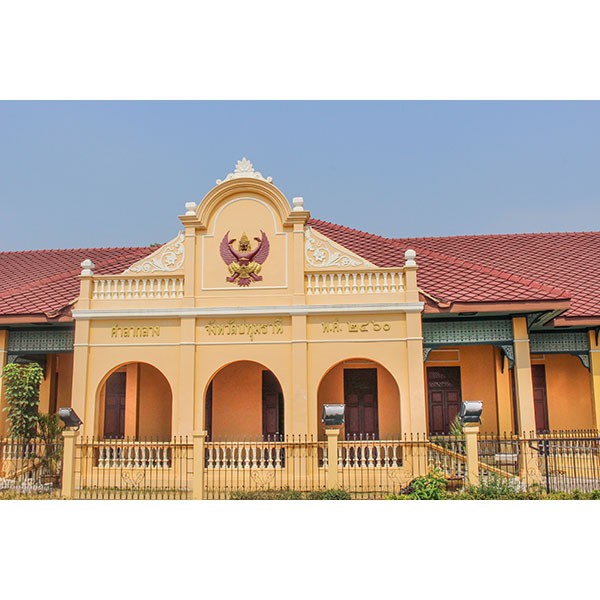
The city hall, crafted from brick and cement, reflects a strong influence of Western art, a testament to the cultural exchanges during that era. Its ground floor is elevated approximately one meter, with the space below enclosed with cement, and features double porches above. The structure includes extension wings on both sides, with a rectangular building positioned behind the porches. The European-styled balustrades that line the edges of the roof in front of the building add to its aesthetic appeal. A garuda, serving as a symbol, is installed at the top, with a cement roof above. The porches and terraces feature perforated designs, while the ventilation channel and double door frames are crafted from wood. Recognized for its historical and cultural value, the city hall was registered as one of the ancient remains in the Royal Thai Government Gazette on February 18, 1996, covering an area of 8 rais, 2 ngans, and 3 square wahs.
Financial and Cultural Support for Preservation
The Department of Cultural Promotion of Pathumtanee Province has received financial backing from the province, aligning with a local museum project. This initiative, with a budget of 6,595,000 baht, was carried out from September 1, 2003, to April 28, 2007. The support underscores the importance placed on preserving cultural heritage and promoting local history.
—
Detailed Examination of the Transformation and Relocation
In the early 20th century, the transformation from Mueang to Province marked a pivotal moment in Thailand’s administrative history. This change was not only a linguistic shift but also a move towards a more structured and efficient governance system. King Rama VI’s vision aimed to modernize the administrative framework, reflecting broader global trends of centralization and standardization in governance.
The Move from Kok Chaplutai to Tambon Bang Prok
The relocation of administrative offices from Kok Chaplutai to Tambon Bang Prok was a strategic decision. It involved moving critical infrastructures, such as the city hall and governor’s residence, across the Chao Phraya River. This shift was likely driven by several factors, including geographical advantages, accessibility, and perhaps the need for a fresh administrative start that aligned with the new provincial status.
Architectural and Cultural Influences
The architectural style of the city hall, influenced heavily by Western art, signifies the cultural exchanges occurring during King Rama VI’s reign. The building’s design, with its elevated ground floor and European-style balustrades, reflects a blend of local and Western architectural elements. The presence of a garuda symbol at the top of the building connects it to Thai cultural and religious symbolism, serving as a bridge between tradition and modernity.
The Role of Cultural Preservation
The 1996 registration of the city hall as an ancient remain highlights the importance of cultural preservation. This designation not only acknowledges the building’s historical significance but also ensures that future generations can appreciate this piece of heritage. The financial support provided by the Department of Cultural Promotion for its preservation as part of a local museum project further emphasizes the commitment to maintaining cultural landmarks.
—
The Broader Implications of Governmental Reforms
The changes initiated by King Rama VI in 1917 were part of a broader movement towards modernization in Thailand. By redefining administrative boundaries and relocating key offices, the government aimed to streamline operations and promote a more coherent identity for the newly designated provinces.
The Impact on Local Communities
For local communities, the shift from Mueang to Province and the relocation of administrative centers represented a new era. These changes likely brought about improvements in infrastructure, governance, and public services. However, they may have also posed challenges, such as the need for communities to adapt to new administrative processes and the potential disruption caused by relocating established offices.
Legacy of King Rama VI’s Reforms
King Rama VI’s reforms have had a lasting impact on Thailand’s administrative landscape. By promoting a more organized and standardized system of governance, these changes laid the groundwork for future developments. The influence of Western culture during this period, as seen in the architectural style of the city hall, also reflects the king’s broader vision of integrating global ideas while maintaining a distinct Thai identity.
Ongoing Efforts in Cultural and Historical Preservation
The ongoing efforts to preserve historical sites like the city hall underscore the importance of cultural and historical preservation in contemporary society. These initiatives ensure that the rich history of Thailand’s administrative evolution is not lost and continues to be accessible to future generations. The support from the Department of Cultural Promotion and the financial investment in local museum projects demonstrate a commitment to celebrating and preserving Thailand’s diverse cultural heritage.
—
By examining the transformation of Mueang to Province and the associated architectural and cultural developments, we gain valuable insights into Thailand’s historical trajectory. This period of change, marked by King Rama VI’s reforms, continues to influence the country’s administrative and cultural landscape today, reflecting a delicate balance between modernization and tradition.
Address And Location:
Bang Parok Mueang Pathum Thani Pathum Thani 12000