Key Takeaways
Wat Si Sa Thong: A Historical Overview
Wat Si Sa Thong, originally known as Wat Hua Thong, has a storied past that dates back to the early Rattanakosin Era, as chronicled in the royal gazette of 1815. This temple has long served as a spiritual hub for the Lao community and other nearby populations. Initially, the area surrounding Wat Si Sa Thong was deserted due to its distance from the river. During the reign of King Rama I, the revered Phra Kaew Morakot was transferred from Vientiane to Bangkok, prompting some Lao people from Vientiane to relocate to Bangkok as well. Some settled in the Ban Kluai area, while others established themselves in what is now known as the Si Sa Thong sub-district. They cleared the land to establish a temple, and during their excavation, they discovered a golden head of a Buddha statue. This discovery was seen as an auspicious sign, leading them to name the temple "Hua Thong," which translates to "Golden Head."
The Relocation and Renaming of the Temple
Later, the government undertook the construction of a canal from the Tha Chin River (also known as the Nakhon Chai Si River) at Ton Son market. This project was designed to facilitate the king’s journey to Phra Pathom Chedi. Consequently, the residents had to relocate to live along the Khlong Chedi Bucha canal. During this period, the temple was also moved to accommodate the new traffic routes, and its name was changed to Wat Si Sa Thong. Today, it stands as an ancient temple in the Nakhon Chai Si district of Nakhon Pathom province, home to numerous ancient items and archaeological sites.
Cultural and Educational Significance of Wat Si Sa Thong
Wat Si Sa Thong has been a center for the study of astronomy, astrology, and herbal medicine since its inception. The temple’s first abbot was Luang Pho Tai, a Lao immigrant from Vientiane. He resided at the temple from its humble beginnings as a little-known establishment until it gained wider recognition. The current abbot is Phra Khru Winai Thara Manit Thisaro.
—
Detailed Exploration
Establishment and Early History
The origins of Wat Si Sa Thong can be traced back to the early 19th century, a time characterized by significant political and cultural shifts in the region. Founded during the Rattanakosin Era, the temple was initially named Wat Hua Thong, reflecting its unique discovery story. As the Lao people relocated to Bangkok following the movement of Phra Kaew Morakot from Vientiane, they brought with them their traditions and spiritual practices. The establishment of the temple was not merely a religious endeavor but also an assertion of cultural identity in a new land.
The discovery of the golden Buddha head during the temple’s construction was interpreted as a divine blessing, bestowing the temple with its original name, Hua Thong. This discovery was a pivotal moment that solidified the temple’s place as a spiritual and cultural beacon for the Lao community and beyond.
Government Initiatives and Temple Relocation
The Thai government’s decision to develop infrastructure in the form of a canal from the Tha Chin River was a critical factor in the temple’s relocation. This canal was intended to ease the king’s travels to Phra Pathom Chedi, underscoring the importance of connectivity and accessibility in the region. The relocation of the temple to its current site by the Khlong Chedi Bucha canal was a strategic move that mirrored broader urban planning initiatives of the time.
Renaming the temple to Wat Si Sa Thong marked a new chapter in its history. This change not only reflected its geographical shift but also integrated the temple into the evolving socio-political landscape. The temple’s new name and location enhanced its role as a cultural and spiritual cornerstone, drawing devotees and scholars alike.
Architectural and Archaeological Richness
Wat Si Sa Thong is not only a place of worship but also an invaluable repository of ancient artifacts and archaeological treasures. The site is home to numerous relics that offer insights into the region’s historical narrative. These artifacts, ranging from ancient sculptures to inscriptions, provide a window into the past, illustrating the temple’s enduring significance through the ages.
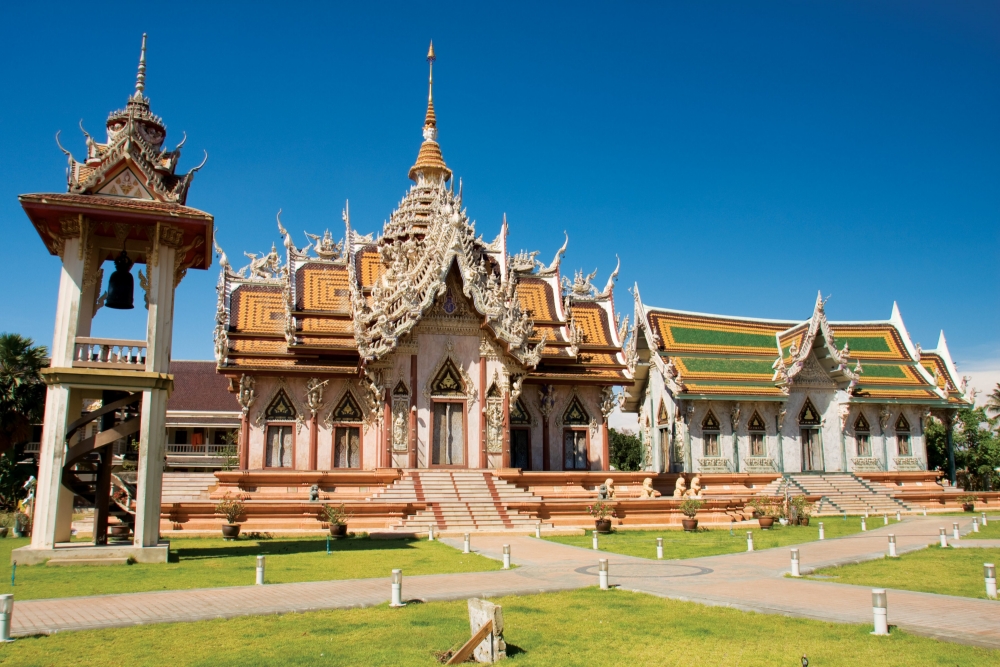
The temple’s architecture itself is a testament to the skilled craftsmanship and aesthetic sensibilities of the era. The intricate designs and structural elements of the temple buildings reflect a harmonious blend of traditional Lao and Thai architectural influences. This fusion of styles is emblematic of the cultural exchanges that have shaped the temple’s identity over the centuries.
Educational Role in Astronomy, Astrology, and Herbal Medicine
From its inception, Wat Si Sa Thong has been a hub for intellectual and spiritual exploration. The temple’s dedication to the study of astronomy and astrology highlights the deep connection between celestial phenomena and spiritual beliefs in the region. These disciplines were not merely academic pursuits; they were integral to the cultural and religious fabric of the community.
Herbal medicine, another field of study at the temple, underscores the holistic approach to health and wellness that has been practiced for generations. The temple’s role in preserving and disseminating knowledge about herbs and natural remedies reflects a profound understanding of the interconnectedness of the natural and spiritual worlds.
Leadership and Legacy
The temple’s leadership has played a crucial role in shaping its trajectory. The first abbot, Luang Pho Tai, was instrumental in establishing the temple’s reputation as a center of spiritual and cultural learning. His vision and dedication laid the foundation for the temple’s growth and development.
Under the stewardship of the current abbot, Phra Khru Winai Thara Manit Thisaro, Wat Si Sa Thong continues to thrive as a place of worship and learning. The ongoing efforts to preserve and enhance the temple’s historical and cultural assets ensure that it remains a vibrant part of the community.
Conclusion
Wat Si Sa Thong stands as a testament to the enduring legacy of cultural and spiritual interconnectedness. Its history is a narrative of relocation and renaming, reflecting broader socio-political changes while maintaining its core mission as a center of learning and worship. The temple’s rich tapestry of history, architecture, and education continues to inspire and enlighten visitors and devotees, affirming its place as a cornerstone of cultural heritage in Nakhon Pathom province.
Address And Location:
Sisa Thong Nakhon Chai Si Nakhon Pathom 73120