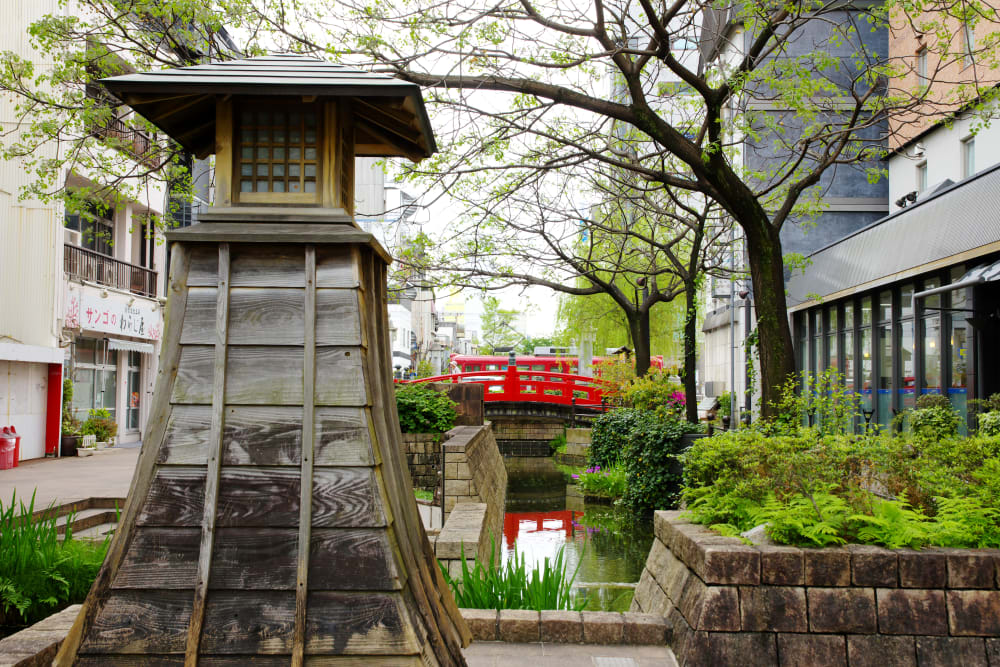
The scene of Kochi’s most famous ill-fated love affair, featured in song and cinema, is the Harimaya Bridge. This bridge holds a significant place in the history and culture of Kochi, japan. It has come to symbolize love because of an ill-fated affair that took place in the 19th century.
The story revolves around a monk named Junshin, who was a priest of Chikurinji Temple on Mt. Godai, and a tinker’s daughter named Ouma. Junshin was bound by his vows of a solitary life, but his emotions got the better of him, and he bought a hairpin for his secret love from a shop next to the bridge. In that era, monks were forbidden to fall in love, and when word of Junshin’s outrageous act spread, both he and Ouma were banished. Despite the consequences, the memory of their ill-fated affair lives on in song and cinema.
The Harimaya Bridge is considered one of Kochi’s most popular sightseeing spots. Throughout the ages, the bridge has been repeatedly torn down and rebuilt, but its significance remains unchanged. It has become a symbol of love and forbidden romance, attracting tourists from all over the world.
In 2009, the bridge gained even more attention when it was featured as a central location in the movie “Harimaya Bridge.” The film tells the story of Junshin and Ouma, bringing their ill-fated love affair to life on the silver screen. The movie further solidified the bridge’s reputation as a place of love and tragedy.
To visit the Harimaya Bridge, you can take the tram from Kochi Station to the Harimayabashi stop. It is the third stop from Kochi Station. Once you get off the tram, you can easily reach the bridge by crossing over the large intersection. It is just a short walk away.
The bridge itself holds immense historical and cultural significance. It has witnessed the passage of time and has been witness to countless love stories, both happy and tragic. The ill-fated love story of Junshin and Ouma is just one of the many tales associated with the bridge.
Every year, the story of Junshin and Ouma is recounted in the lyrics for the city’s Yosakoi Festival song. The Yosakoi Matsuri is Kochi’s biggest annual event, held every summer in August. It brings together more than 10,000 dancers who celebrate life, the harvest, and the city’s prosperity. The festival is a vibrant and colorful display of Japanese culture and traditions.
Not only is the Harimaya Bridge a symbol of love, but it is also a scenic spot that offers breathtaking views of the surrounding area. The bridge itself is a beautiful structure, and the nearby shops sell kanzashi hairpins and sweets and cookies with hairpin designs. These souvenirs serve as a reminder of the bridge’s history and the enduring love story of Junshin and Ouma.
Visiting the Harimaya Bridge is not just a sightseeing experience; it is a journey into the past and a chance to connect with the rich cultural heritage of Kochi. The bridge stands as a testament to the power of love, even in the face of adversity. It reminds us that love knows no boundaries and can transcend societal norms and expectations.
In conclusion, the Harimaya Bridge in Kochi, Japan, is a symbol of love and tragedy. The ill-fated love affair between Junshin and Ouma has immortalized the bridge in song and cinema. It is a popular sightseeing spot and a must-visit destination for tourists seeking to experience the rich history and culture of Kochi. The bridge’s significance extends beyond its physical structure; it represents the power of love and the human spirit to defy societal constraints. Standing on the Harimaya Bridge, one can’t help but feel a sense of awe and connection to the past, where love and tragedy intertwine. So, if you ever find yourself in Kochi, make sure to visit the Harimaya Bridge and immerse yourself in its captivating story.
Address And Maps Location:
1-5 Harimaya-cho, Kochi-shi, Kochi-ken
Find Location And Direction On Google Maps
Subscribe, follow travelbloggerindonesia.com